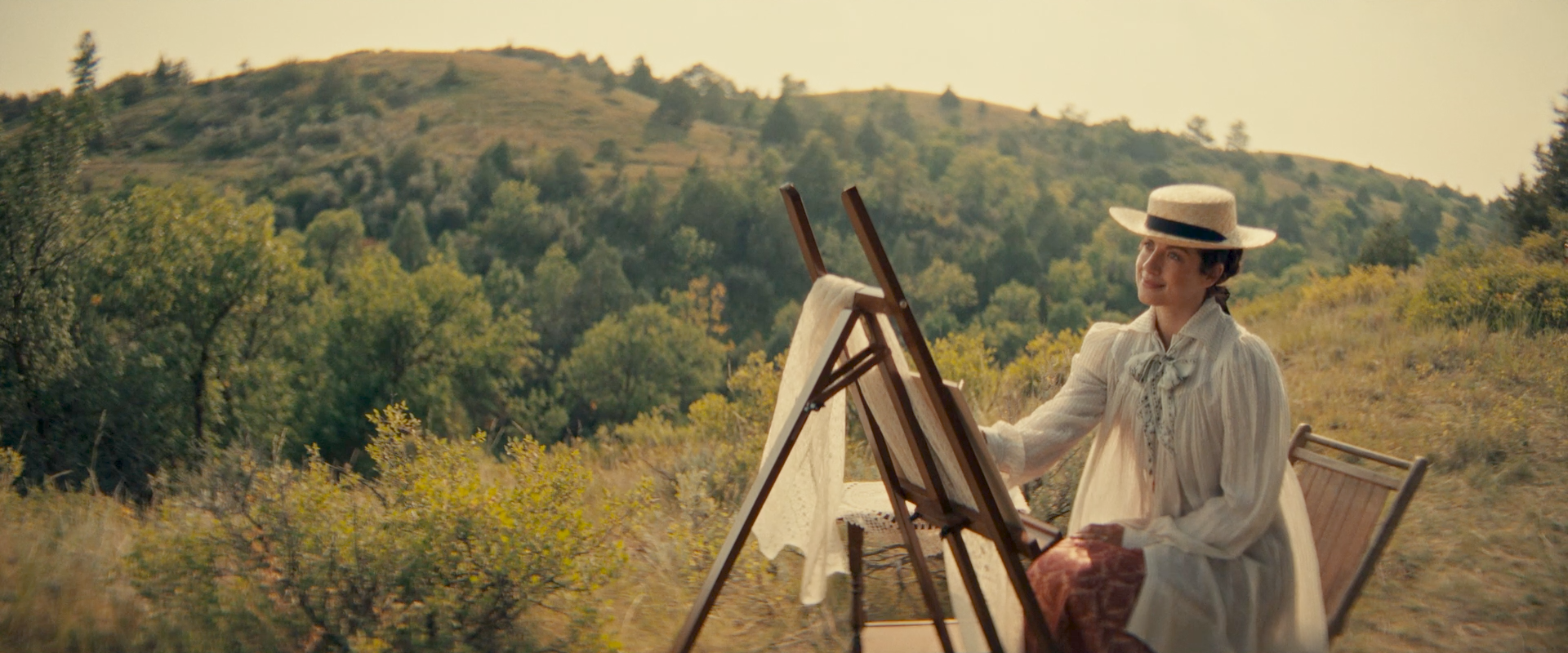

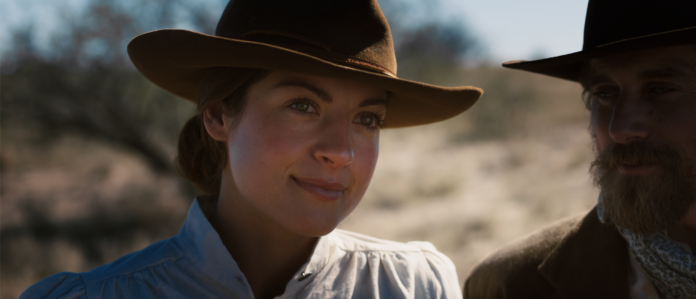
Baylee Toney shines as Medora in Medora: Empress of the Badlands.
The incredible true story follows the Marquis de Mores and his beautiful new bride Medora. They step off the train into 1883 Dakota Territory with dreams of building a new home, a new town, and a meat-packing empire the like of which has never been seen before. Little did they know the odds they would face: prejudice and persecution from local ranchers; sabotage from beef trusts in the bigger cities; violent attacks from local roughnecks bent on killing them or driving them from Dakota Territory once and for all. You can watch the trailer here.
The Oregon born actress, director, and writer discovered her love for performing during her time with the Rogue Ballet where she danced in the Medford Criterion Theatre’s acclaimed “The Nutcracker” for 8 years in addition to Ashland’s Ballet in the Park. Baylee attended Oregon Institute of Technology on a full basketball scholarship. After college, Baylee moved to NYC to pursue her career in acting. During her time in New York City, she studied acting at The Barrow Group. Baylee kick-started her in the western ‘The Redeemer,” where’s she fell in love with the western genre and created a niche for herself playing characters in the Wild West. Her passion for this genre led her to direct her first feature (a modern western) “Last Tour Home.” She is an expert level horseback rider, and has extensive experience in a range of Southern and Eastern accents.
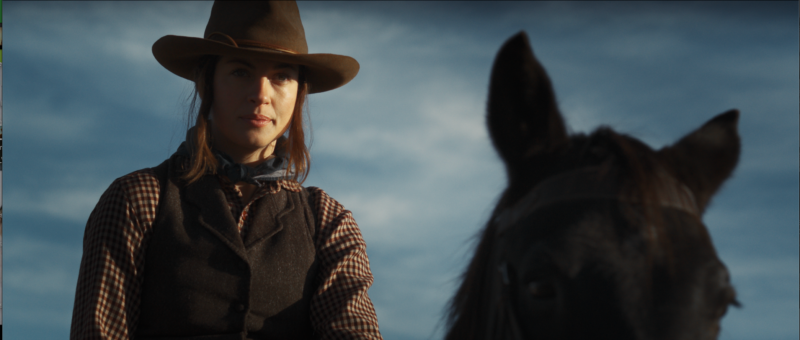
Check out our interview with Baylee:
What is it about the western genre that you personally love?
Baylee: Westerns have a way of getting into your soul. The landscape and setting immediately become characters themselves. I’ve fallen in love with the timelessness the genre embodies. As an actress and director, I want to be part of films that stand the test of time, and being welcomed into the western genre feels like such a gift.
There’s something powerful about portraying grit, sacrifice, determination, and strength the way westerns demand. At this stage in my career, I’m especially interested in showcasing women of the West beyond the stereotypes we so often see in film. I want to explore their skill, resilience, humor, complexity, and personality. Not just making female characters “strong” for the sake of optics, but showing who these women truly were beyond being wives or background figures.
You play Medora Von Hoffman. Did you know about her prior to joining the film?
Baylee: I actually had no idea who Medora was before joining the project. When I first researched her, I quickly realized the world also had a limited understanding of who she was. Much like today, I think her brilliance and grit were often overshadowed by her husband, the Marquis de Morès.
When I first searched her name, the top result described her simply as “wife of the Marquis,” which both saddened and inspired me. The more I researched, the more I discovered she was an extraordinary woman. She was a mother, a New York socialite who came West for love, a woman who spoke several languages, and someone who once led women on a hunting trip and returned with several bears.
She deserved to be remembered for far more than being someone’s spouse. At the same time, the film deeply explores her marriage, which allowed me to examine who she was within that relationship.
How did you prepare to play her?
Baylee: I spent as much time as possible researching the time period. Unfortunately, there wasn’t a lot of information available about Medora herself, so I took what I could find and built her from the inside out.
What stood out most to me was her grit, determination, and deep devotion. I focused on who she was within her relationships: her relationship with the Badlands, her new home, her father, and especially her husband. She was a deeply devoted woman, and that became the emotional core of my performance.
I also worked with a dialect coach who had worked on The Gilded Age. It was important to me that she sounded eloquent, educated, and authentic to a woman from 1800s New York City. All of that, combined with wearing corsets and heavy dresses every day, helped me fully step into her world.
Did it excite you to play a real person, or did it add pressure?
Baylee: There was definitely pressure. Medora is a real town in North Dakota, and her presence is still deeply felt there. The château she lived in is now a historic site, there’s a sculpture of her on the town’s main street, and no film had ever told her story before.
Taking on Medora for the first time felt like a huge responsibility, but also an incredible privilege. Getting to premiere the film in Medora with the local community was one of the best experiences of my life. I hope I brought truth and soul to a woman who means so much to the people of North Dakota and the American West. I also hope this film helps place her alongside iconic women like Annie Oakley and Calamity Jane.
What was it like stepping into the late 1800s?
Baylee: I’ve become very fond of this time period. I’ve worked on several projects set in the late 1800s, and instead of tiring of it, I only fall more in love with it each time.
There’s something beautiful about stepping back into that world. The wardrobe, horses, dirt roads, small towns, and shooting outdoors all feel incredibly immersive. I hope I continue getting to explore different characters from this era because it was such a monumental period in the history of the American West. I’d especially love to play a grittier version of Annie Oakley someday.
If you could bring anything from the late 1800s into 2026, what would it be?
Baylee: I would bring back a simpler relationship with technology. I appreciate modern conveniences like electricity and air conditioning, but I wish people communicated more through letters and meaningful conversation instead of constantly living on phones and social media.
I’d love to see more people outside, enjoying nature and being present instead of staring at screens all day.
I heard you filmed in Medora and Bismarck, North Dakota. What was it like shooting on location?
Baylee: It was such a joy. Filming at the château where Medora once lived, visiting local saloons, meeting the townspeople, and standing in the Badlands under the stars truly helped me connect to her.
There’s a line in the film where a character says, “They’re called the Badlands. They get in your soul, they do,” and that couldn’t be more true. The Badlands absolutely got into my soul, and they’ll stay there forever.
What are you most excited for audiences to see in Medora: Empress of the Badlands?
Baylee: When I saw the film for the first time at the premiere, I was incredibly moved. It felt timeless. Huge credit goes to our director, Daniel Belinski, for creating something that feels classic and enduring.
I’m most excited for audiences to experience the chemistry and love story between Medora and her husband. To me, it feels like one of those sweeping romantic films you can revisit over and over and still discover something new each time.
What do you hope audiences take away from the story?
Baylee: I hope people leave feeling that devotion and loyalty are beautiful things. Integrity can come with sacrifice, but it’s one of the most valuable qualities a person can have.
I also hope audiences feel more connected to the people and history behind the founding of Medora. Since Medora herself is often less talked about than her husband, I hope this film helps honor her legacy and encourages more people to learn about the remarkable woman she was.
According to IMDb, you have several upcoming projects. What can you tell us about them?
Baylee: Yes! I’m incredibly excited about everything coming up this year. Of course, Medora: Empress of the Badlands will be released later this year, and I’m very proud of it.
I also wrote, directed, and starred in Run Honey Run, a quirky Bonnie and Clyde-inspired western that I shot in the Badlands. It’s another period western and will premiere later this year.
I also wrote, directed, and starred in Timber Lands, a modern western featuring Wes Studi, Irene Bedard, Robert Clohessy and Tanaya Beatty. We’re currently locking in distribution, and I’m really excited for people to see it.
Additionally, I starred in the western Make the Devil Pay, directed by Kenny Bryant and Emily Binns. It’s a beautiful story that I’m excited to see.
I also recently wrapped PENNY, a 1970s New York drama that I directed and starred in alongside Joanna Gleason, Julianna Margulies, Michael Paré, and Lio Tipton. We’re hoping to have the film completed by late summer.
I also directed a short film called Insufferably Bourgeois! shot in Jersey in the Channel Islands, which I hope will premiere later this summer and eventually grow into a feature film.
And finally, I’m currently developing my next feature, The Apology Tour, which I’ll be directing in Texas. I’m keeping the plot under wraps for now, but I’m incredibly excited about it and feel very grateful for everything happening right now.