

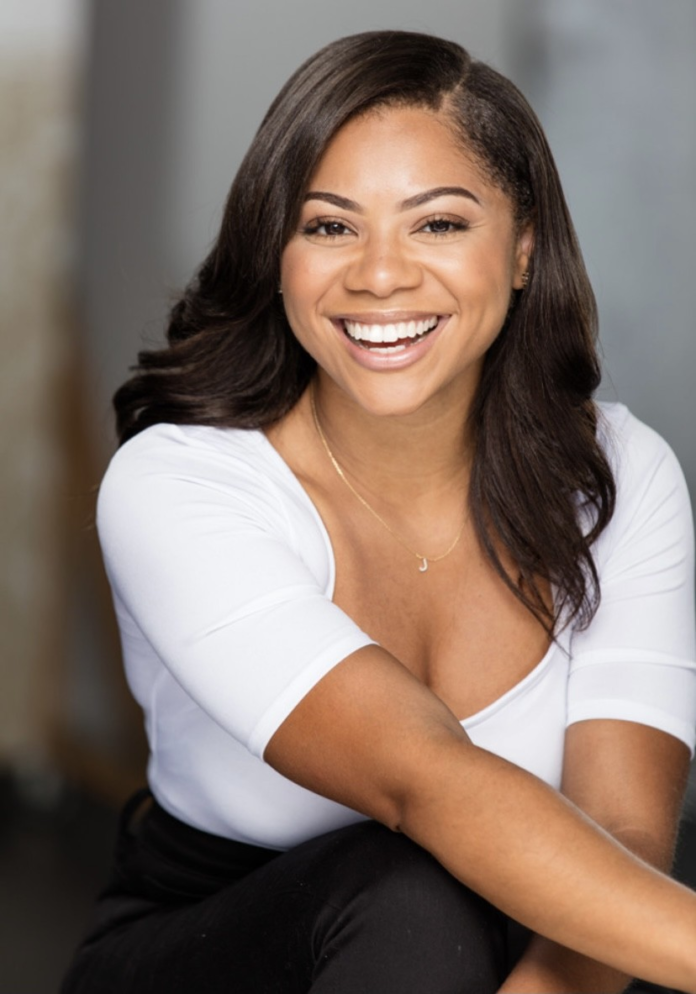
We caught up with Jhone Lucas as she gets ready to film season two of the award-winning and critically acclaimed docuseries, The Gen Zone.
Created by producer Damien Douglas and hosted by Jhone, The Gen Zone is an interactive weekly news show delivering a fresh, youth-driven take on national and international politics. The series blends sharp political insight with viral moments and meme culture—making current events, elections, and policy conversations accessible and engaging for Gen Z and millennial audiences. As both host and co-producer/writer alongside Damien, Jhone plays an integral role in shaping the show’s editorial voice and cultural impact.
In addition to her work in political media, Jhone has built a dynamic career as an actress. She honed her craft in her native Omaha, quickly establishing herself as one of the city’s most promising young performers. After graduating from Creighton University, she moved to New York City to pursue acting professionally, landing her first television role on Spike Lee’s Netflix comedy-drama series She’s Gotta Have It.
Now based in Los Angeles, she has amassed 18 film and television credits spanning drama, comedy, and action. Her recent projects include the 2025 international action thriller To Get Her (starring alongside Amber Stevens West and Paie Hurd) and the 2024 sci-fi thriller Lunar Lockdown with LisaRaye McCoy. She will next be seen leading the cast of the upcoming action thriller Critical Impact.
Check out our interview with Jhone:
I’m very excited to learn more about The Gen Zone. It seems like an incredibly cool project.
Jhone: I think it’s definitely a voice for the younger generation, to get them aware of what’s going on in our political climate and keep them informed. So that when it’s time to go to the polls again, we have some information to help with that.
And you’re not only the host, you’re also a coproducer and a co-writer. Were you a part of this project from its inception?
Jhone: Yes, from the very beginning. We started The Gen Zone in 2020, during the pandemic, when we were noticing the rise of TikTok. A lot of people were doing a lot of self-journalism and storytelling. We wanted to do an event in Atlanta where we registered people to vote, and it was a great, great turnout, and we realized, “okay, this is something that people want more of.” So, we decided to create a show where we informed the youths—really it is targeted towards Generation Z, that’s why it’s called The Gen Zone. We just wanted to help them be informed about what was going on in politics, because the youth is the largest voting bloc, and I think we did a good job of doing that. We had a pretty successful run. And then we were able to become a part of Fox Soul and their lineup, and then, for the first time last year, we got the opportunity to do it as a documentary series with BET.
From my understanding, the docuseries sits at this intersection between politics entertainment and then internet culture as a whole. How did you and Damien find that perfect recipe for this?
Jhone: We knew that we didn’t want news to be boring like we didn’t want to use the same format that you see on CNN or Fox News. We knew that just having a talking head or a reporter, so to say, reading off of a teleprompter, would be nothing to make us different or set us apart from what already exists. So, the recipe that we chose is to incorporate things to make it more relatable. So, we incorporate meme culture and different things that Gen Z really connect to, and I feel like that got people’s attention. Because that’s another thing too, the attention span of the younger generation is not that long, so we needed to have something to grab their attention and then keep them wanting to watch for the rest of the episode.
Where do you get your Gen Z knowledge from? I’m a teacher and I have a really hard time understanding my students.
Jhone: Honestly, I think just internet culture, like, there are so many different platforms, right? You have X, you have Threads, you have Instagram, and you have TikTok. I feel like Gen Z is not really on Facebook. I think that’s the last place that I would go to get any trends or anything.
Social media gives us this wide array of things to experience, and we can communicate all over the world, but they also have the ability to create echo chambers. So with a politically charged docuseries, how do you combat the echo chambering of Gen Z?
Jhone: Here’s the thing with The Gen Zone—we’re bipartisan and we’re unbiased, so we’re not necessarily Republican or Democrat. We just want to put the facts out there, and then you decide whatever you want to do with that.When it comes to social media and our social media page, I mean the hashtags and stuff that we use make sure that it’s bipartisan, it’s for both sides, so that we don’t get caught into a trap of being only on the Republican side of the internet, or only on the Democrat side. That was something that we paid a lot of attention to because the platforms that we were on are necessarily more left leaning, and we didn’t want to come off that way.
It seems like nowadays it is very hard to for any media platform, even in mainstream news broadcasts, to be bipartisan. So, kudos to you for being able to do that.
Jhone: Yeah, it’s hard, especially with everything that’s going on today. It’s kind of like the media almost makes you pick a side, but that’s just because our current administration is so divisive in that way.
So, with that said, what is season two going to focus on?
Jhone: The theme for season two is the “United States of Amnesia.” So, we’re going to be circling or focusing on different ways that we may see history repeating itself.
Oh, I like that.
Jhone: Yeah. A quick example is the voter ID bill, that they’re trying to pass in Congress right now, and how that’s going to affect and impede on people’s ability to vote, similar to not that long ago, when minority people had to take and pass literacy tests before they were able to vote. Another one that we’re circling on, even more recently, are weapons of mass destruction and now the nuclear missiles that are being made in Iran. History is just repeating itself. We also had some cameras capturing some of the ICE protests here in downtown LA, and how you could see some similarities between the ICE officers and the Nazis during World War Two. Those just a those are just a few examples.
How do you work with the heaviness of it all?
Jhone: It’s kind of like, you know, laugh at your pain. If you make light of a situation, then it doesn’t feel as heavy. But we also understand that what we’re talking about is very serious. It’s kind of like our civic duty to make sure that we’re aware and informed of what’s going on. So, we understand the task that we have is very serious, but at least we can get a joke in here and there to make it not so exhausting. You know? Like, geez, the world is ending. But no one wants to hear that.
Another thing that is prevalent is the idea of like, “okay, you talked about this, but what about this other topic?” And it’s kind of like there’s this never ending satiation for covering every topic. How did you choose what to focus on for season two?
Jhone: It helps that we’re doing another documentary series because the format for the podcast was just what happened in the news this week. If we still had that kind of format, then it would be this monumental thing where every day there’s new news. Because it’s a documentary series, we’re kind of able to navigate the story in a different way. The last documentary series we did followed both presidential campaigns, so that kind of was the theme that navigated what was going on in that documentary series. You knew that from the first episode to the last episode, we were capturing the perspective of Generation Z, and we were capturing the perspective of the country for a presidential election that was historic, you know? With this, it’s kind of under that same vein. We have the “United States of Amnesia” and so an episode is going to be talking about history repeating itself in one way, and how that affected communities back in the day versus how it’s affecting communities today when it’s happening again. We are using that theme to guide us. That way we don’t get lost and caught up in trying to talk about everything. There’s so much, like, even with the Epstein files, we were just talking like, ‘are we even going to touch base on that in the documentary?’ Because technically, it is political, it is in the news, but does it go along with our theme? We’ve been having those conversations and are really trying to stay on theme, and that’s how we’re not going to, you know, fall into the trap of taking on this giant elephant.
What do you hope people take away from season two?
Jhone: When we were on the road shooting season one, I realized, like very early on, that Trump was going to win just from the attitudes of the youth and the interviews that we were getting. So, I guess my hope for this season is that if we are aware of things that have happened in the past, then when it shows up again, we can call it out and we can challenge it. My hope is that I present the information to people in a way that when they realize history is kind of repeating itself, they’re able to recognize it, call it out, and then do something about it. We can stop it from happening again.
Production for season two is starting up soon. When do you hope this will be available?
Jhone: Hopefully by November. We’re hoping to start shooting in June, and we want to capture—some primaries would have already happened—but we want to capture this midterm season.
You can catch up with The Gen Zone season one on BET+